


A reader's own account
“I stopped blaming the season, and the mornings finally changed”
She had cleaned the same bedroom the same careful way for years. What changed the air was not another clean.

What actually changed the air in her bedroom
Nothing about how she cleaned. Something about what she cleaned for.
For a long time the routine was the routine: bedding stripped and washed hot every week, the mattress gone over with the hoover, the window cracked each morning to let the room breathe. On paper the room was faultless, and for a night or two after a deep clean it even felt that way.
Then, reliably, it slid back. A thick head on waking, a throat that felt used, a nose that cleared by lunchtime and blocked again the moment she lay down. She had put it down to the time of year, to getting older, to a house that was simply old. None of those explanations ever fixed a single morning.
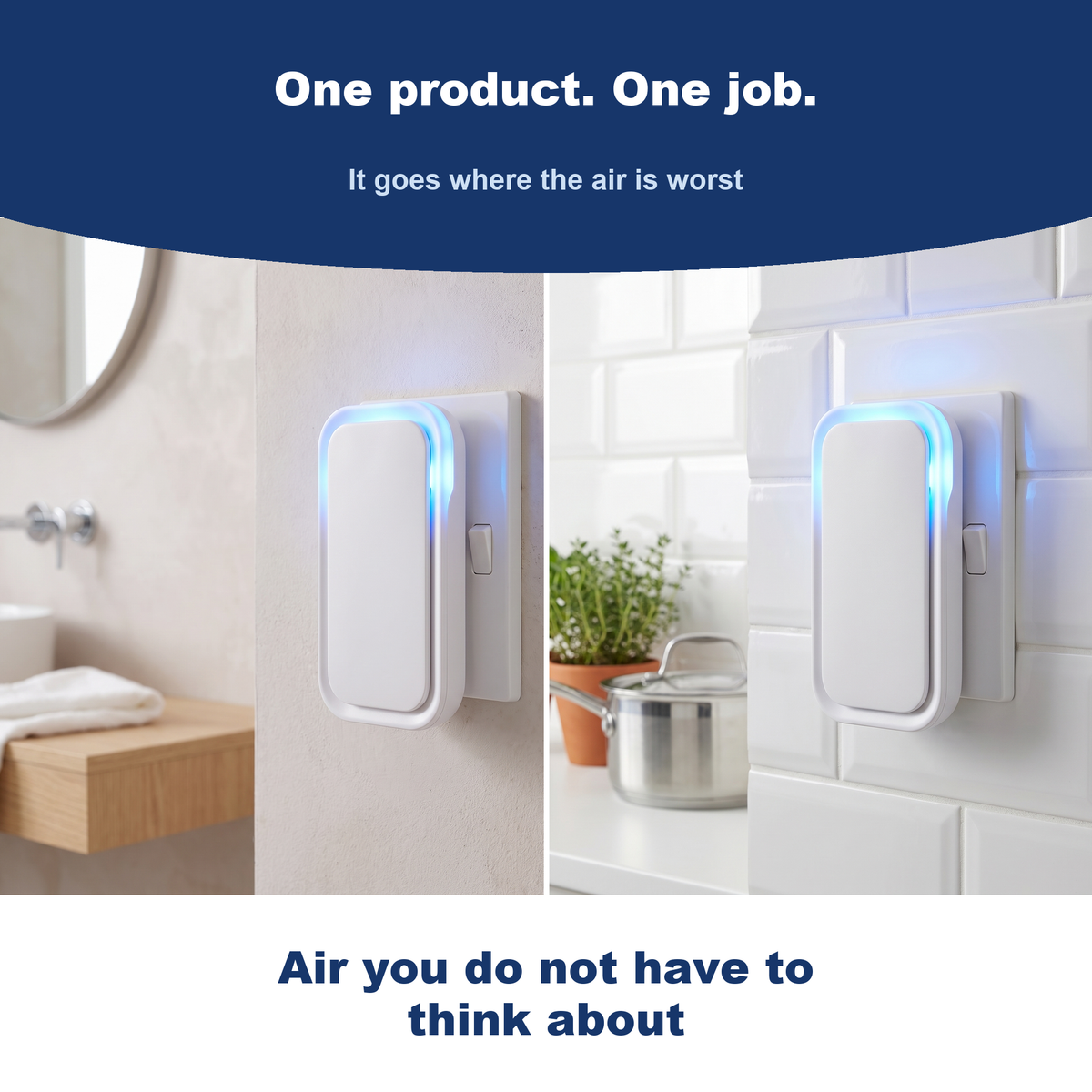
The thing she had been treating was the surfaces. The thing that was actually bothering her was in the air above them — the light fraction of house dust that a cloth and a hoover push around rather than remove. A slim plug-in ioniser went into the socket beside the bed and was left there. It puts negative ions into the room; the ions cling to what is drifting until it is heavy enough to fall, and it settles where a hoover can finally pick it up.
What other women report
The same shape of story, over and over
Read enough of what people say about a plug-in ioniser in a bedroom and the accounts start to rhyme. The wording changes; the shape does not.
- “The first week I honestly thought it was in my head. By the third the difference in the mornings was not in my head at all.”
- “What sold me was the quiet. It sits by the bed and you forget it is there — no fan, no hum, nothing to switch off.”
- “I had already bought a big purifier and given up on the filters. This just stays in the wall and does its job.”
Composed from the recurring themes people raise, not individual reviews — the specific points come up again and again: the change is gradual, the silence matters, and there is nothing to keep buying.
Editorial test: four weeks with it
We left one plugged in and simply paid attention
Rather than promise a number, we did the honest version: one unit in one bedroom, left running, with everything else about the cleaning kept exactly as before. Here is what four weeks actually looked like.
- The first days. Nothing dramatic. The unit was working from the moment it was plugged in, but the air in a room turns over slowly and the mattress keeps feeding it, so a plug-in is not a switch you flip.
- The middle stretch. The first thing to change was the room rather than anything you could measure — it stopped feeling closed by the evening.
- By the fourth week. The waking head that used to be part of the morning was the exception rather than the rule. Not a cure, not a miracle — a room that had stopped working against the person sleeping in it.

Our verdict
Worth it for the right problem, and honest about the wrong one
If your trouble is a room that looks spotless and still leaves you stuffy and heavy in the mornings, this is aimed squarely at that. It works on the part cleaning never reaches, it is genuinely silent, and there is no filter to buy for as long as you own it.
It is not a HEPA purifier and it will not scrub smoke or cooking smells out of the air, and we would rather say so than oversell it. For the specific job of weighting airborne dust and mite allergen so it drops out of the air you breathe at night, it does what it claims — quietly, and without asking anything of you after it is plugged in.
The reader-only promotion
A better price for taking more than one
An ioniser only works on the air in the room it is in, so the people who get the most from it tend to cover more than the bedroom — the living room where the evenings happen, the spare room that gets used when someone stays. That is where the saving is, and it is applied for you the moment you pick a multi-pack: nothing to type in, nothing to remember.
Take a pair and it works out around a quarter off each unit; the popular four covers a normal home for about forty per cent less per unit; the six for a larger house or a couple to give away reaches the full 52% off.
90 days to try
90 nights to decide, in your own bedroom
Because the change is gradual, a week is not a fair trial. So the window is 90 days — long enough to live with it through a proper stretch of ordinary nights and judge it on the room, not on the first morning.
Plug it in, carry on exactly as normal, and if the mornings are no different at the end of it, send it back for the full amount. We cover the return postage, and there is no form to argue your way through.
Why does it cost so little
The honest reasons the price is what it is
The first question a low price should raise is what is missing. Here the answer is deliberate. There is no fan and no filter, which is most of the moving cost and all of the running cost designed out on purpose — not a corner cut.
It sells directly rather than through a shelf in a chain that takes its own margin, and it is one product rather than a range, made in volume. What you are not paying for is a motor, a stack of replacement filters and a middleman; what is left is a slim plug-in that does one job and keeps doing it.